Connect with us

Breaking News

Federal High Court Adjourn Application To Stop Good luck Jonathan To May 15 For Definite Hearing

Published

on

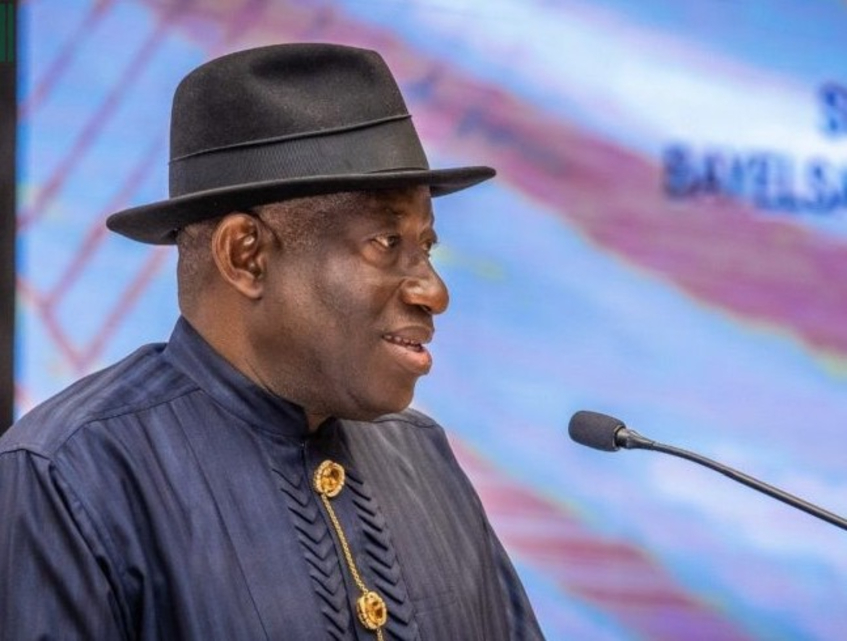
‎Justice Peter Lifu of the Federal High Court in Abuja has set May 15 as deadline for definite hearing in a suit filed by a lawyer, Johnmary Jideobi, seeking to stop former President Goodluck Jonathan from contesting 2027 presidential election.

‎The judge on Monday shifted the hearing date following the absence of the plaintiff, Jideobi, and his lawyer in court without any information.

‎Apart from the absence of the plaintiff, who is a legal practitioner, the Independent National Electoral Commission, INEC, and the Attorney General of the Federation, AGF, and Minister of Justice, who are 2nd and 3rd defendants in the matter, were also not in court.

‎Following the absence of the plaintiff and the two defendants, Chris Uche, SAN, representing former President Goodluck Jonathan, applied to the court to strike out the suit for lack of diligent prosecution.

‎Having joined issues with each other, Uche said, the suit is liable for dismissal with a N5 million cost to be awarded against the plaintiff and payable to Jonathan.

‎He argued that from all indications, the plaintiff has abandoned the suit and ran away upon sighting the preliminary objections raised against the suit, adding that the court is a busy place and not for unserious matters.

‎Justice Lifu however noted that there was no evidence of service of hearing notice on INEC and AGF to appear in court for the suit adding that lack of service of hearing notice is fundamental.

‎The judge said rather than striking out the suit, he prefers to bend backward to accommodate the plaintiff and the two defendants for the last time.

‎While adjourning the matter to May 15, Justice Lifu ordered that hearing notice be served on the plaintiff and the 2nd and 3rd defendants who were not in court on Monday.

‎The plaintiff, Johnmary Jideobi

‎had filed the case seeking an order to restrain Jonathan from presenting himself to any political party as an aspirant for the 2027 election.

‎He is also asking the court to stop INEC from accepting, processing or publishing Jonathan’s name as a presidential candidate.

‎In the suit, the plaintiff asked the court to determine whether, based on sections 1(1), (2), (3) and 137(3) of the 1999 Constitution, Jonathan remains eligible under any circumstances to contest for Nigeria’s highest office again.

‎According to the plaintiff, Jonathan had already exhausted the constitutional limit for the office after completing the tenure of late President Umaru Musa Yar’Adua and subsequently serving a full four-year term following the 2011 election.

‎An affidavit filed in support of the suit by Emmanuel Agida stated that Jonathan assumed office as President on May 6, 2010, after Yar’Adua died a day earlier.

‎Agida said reports suggesting that, Jonathan may be interested in the 2027 election informed the decision to approach the court with the suit.

‎“The plaintiff believes that the 1st defendant, having completed the unexpired term of late President Yar’Adua and subsequently served a full term after the 2011 election, has exhausted the constitutional limit of two tenures as president,” the affidavit stated.

‎The plaintiff further argued that unless the court intervenes, a political party could nominate Jonathan for the election in violation of constitutional provisions.

‎According to the affidavit, if Jonathan contests and wins the election, he would be taking the presidential oath of office for the third time.

‎Agida maintained that the suit was filed in the public interest and to uphold the supremacy of the constitution and preserve the integrity of Nigeria’s constitutional order.

‎Jonathan had said he was consulting on whether or not he should join the 2027 presidential race.

Read The Full Story / Watch The Full Video

Continue Reading
Click to comment

Leave a Reply

Your email address will not be published. Required fields are marked *

Breaking News

Central Bank of Nigeria CBN Has Cautions Non-interest Banks

Published

on

The Central Bank of Nigeria has warned non-interest financial institutions against governance and compliance risks capable of undermining public confidence and financial stability in the country’s growing Islamic finance sector.

The warning was contained in a press statement issued by the apex bank on Monday following the 2nd Annual Interactive Session between the CBN Financial Regulation Advisory Council of Experts and the Advisory Committees of Experts of Non-Interest Financial Institutions held at the CBN Auditorium in Abuja.

Speaking through the Director of the Financial Policy and Regulation Department, Dr Rita Sike, the Deputy Governor, Financial System Stability, Philip Ikeazor, said the rapid expansion of the industry had increased exposure to operational and regulatory vulnerabilities.

The statement read, “The Deputy Governor, however, observed that as the industry grows in size, sophistication, and interconnectedness, it faces unique risks, particularly non-compliance risk, governance challenges, operational vulnerabilities, and emerging technological risks.

“He warned that such risks, if not properly managed, could undermine public confidence, financial stability, and the overall credibility of the non-interest finance ecosystem.”

According to the CBN, the engagement was part of ongoing efforts to strengthen Shariah governance, improve regulatory clarity, and reinforce risk management standards within the non-interest financial services industry.

The apex bank noted that non-interest financial institutions continued to play an increasingly important role in Nigeria’s financial system by providing ethical and Shariah-compliant alternatives to conventional banking.

It stated that the institutions were also contributing to financial inclusion, real sector financing, micro, small, and medium enterprises development, and shared prosperity.

The CBN further explained that the establishment of FRACE and the mandatory constitution of ACEs across all non-interest financial institutions were designed to institutionalise a harmonised governance framework for the sector.

According to the statement, sustained interaction between FRACE and ACEs remained critical to ensuring that regulatory expectations were properly understood and consistently implemented across the industry.
Related News

“The objectives of today’s session include fostering the institutionalisation and effective operation of a robust Shariah governance system within Non-Interest Financial Institutions, and providing a structured platform for dialogue, knowledge-sharing, and collaboration,” Ikeazor was quoted in the statement.

In his remarks, the Deputy Chairman of FRACE, Prof Bashir Umar, said the interactive session was aimed at strengthening governance within the non-interest finance sub-sector and promoting constructive engagement between regulators and industry advisory committees.

He also commended the management of the CBN for reviving the session, which was first introduced in 2014.

Earlier in her welcome remarks, Sike reaffirmed the apex bank’s commitment to building a strong and well-governed non-interest financial services industry.

She noted that the growing diversity of products and delivery channels, particularly the emergence of Islamic fintech, had increased the need for stronger regulatory oversight and continuous engagement among industry stakeholders.

“The growing diversity of products, institutions, and delivery channels, particularly with the emergence of Islamic fintech, underscores the need for continuous dialogue, sound regulatory oversight, and robust advisory input from scholars and practitioners,” she said.

The session featured technical presentations on Shariah non-compliance risks in non-interest banks and the role of Islamic fintech in driving financial inclusion.

Participants at the event included members of FRACE, chairmen and members of various ACEs, managing directors of non-interest banks, senior CBN officials, and representatives of the Bank of Industry and the Securities and Exchange Commission.

The PUNCH earlier reported that experts in Nigeria’s non-interest finance space called for larger and more frequent Sukuk issuances to deepen the market, unlock long-term capital for infrastructure, and widen financial inclusion, as volatility in global markets pushes investors towards asset-backed and ethical instruments.

Read The Full Story / Watch The Full Video

Continue Reading

Business

Nigerian National Petroleum Company Limited And The Nigerian Upstream Petroleum Regulatory Commission Remitted Over N322bn And $116.9m Into The Federation Account After Tinubu Order

Published

on

The Nigerian National Petroleum Company Limited and the Nigerian Upstream Petroleum Regulatory Commission remitted over N322bn and $116.9m into the Federation Account within two months following the implementation of Executive Order 9 signed in February 2026, documents presented at the Federation Account Allocation Committee meetings have shown.

The documents, obtained from presentations made by both agencies at the March and April FAAC meetings, indicated that the remittances followed the Federal Government’s directive mandating the full transfer of crude oil and gas revenues into the Federation Account.

The document for January 2026 remittance was not uploaded by the committee.

Executive Order 9, signed by President Bola Tinubu in February 2026, was introduced to strengthen transparency, improve revenue accountability, and boost inflows into the Federation Account at a time the government is grappling with fiscal pressures and rising expenditure demands.

According to the directive, the President invoked Section 5 of the Constitution of the Federal Republic of Nigeria (as amended), anchored on Section 44(3), which vests ownership and control of all minerals, mineral oils, and natural gas in the Government of the Federation.

Tinubu said excessive deductions, overlapping funds, and structural distortions in the oil and gas sector had weakened remittances to the Federation Account and warned that the practice must end to protect national revenue.

“For too long, excessive deductions, overlapping funds, and structural distortions in the oil and gas sector have weakened remittances to the Federation Account. When revenues meant for federal, state, and local governments are trapped in layers of charges and retention mechanisms, development suffers. That must end,” he said on his verified X handle.

Findings from the FAAC documents showed that the NNPC remitted a total of $29.28m and N42.64bn for March 2026 crude oil and gas receipts, which were shared in April 2026.

The national oil company stated in its presentation that “100 per cent of the total crude oil and gas receipts of $29,278,415.96 and N2,066,841,328.73 were remitted to the Federation in compliance with Executive Order 9 of February 2026.”

The document showed that the receipts came from multiple revenue streams, including Production Sharing Contract profits, crude oil exports, domestic crude sales to the Dangote Petroleum Refinery, gas receipts, and miscellaneous crude and gas earnings.

A breakdown of the March remittance indicated that crude oil export earnings accounted for $25.7m, while PSC profits contributed $3.52m. On the naira side, crude oil export proceeds stood at N37.67bn, while miscellaneous crude revenue amounted to N42.64bn. Gas revenue contributed N34.47m.

The document further showed that PSC profit inflows were split between the Federation Sub-Account and the Federation Account in line with the statutory sharing formula.

According to the presentation, the Federation Sub-Account received 60 per cent of PSC profits, amounting to $11.71m and N826.74m, while the Federation Account received 40 per cent valued at $17.57m and N1.24bn.

The total transfer for the month stood at $29.28m and N42.64bn.

Similarly, the NNPC disclosed that for February 2026 receipts shared in March 2026, it remitted 100 per cent of crude oil and gas earnings totalling $87.63m and N121.34bn to the Federation Account.
Related News

The document stated, “Federation Accounts: 100 per cent of the total crude oil and gas receipts of $87,629,089.84 and N1,957,563,915.65 were remitted to the Federation.” The February figures represent significantly higher inflows compared to March, reflecting stronger crude oil and gas revenue performance during the period.

The figures equal $87.63m, and N121.34bn remitted for February 2026 receipts shared in March, as well as $29.28m and N42.64bn remitted for March 2026 receipts shared in April.

The FAAC documents also showed that the NUPRC separately remitted N34.2bn in March 2026 as revenue collections from royalties, gas flare penalties, concession rentals, and miscellaneous oil revenue.

According to the commission’s presentation, the remittance was made in compliance with its statutory obligation to transfer all collectable upstream petroleum revenues into the Federation Account.

The document read, “This report is a summary of royalties (oil and gas), gas flared penalty, rents, and miscellaneous oil revenue collected by the Nigerian Upstream Petroleum Regulatory Commission and remitted to the Federation Account as statutorily mandated.”

A breakdown of the NUPRC collections showed that oil and gas royalties generated N18.69bn in March 2026, while gas flare penalties contributed N10.2bn. Miscellaneous oil revenue, which includes licences and permits, stood at N4.95bn, while concession rentals contributed N364.06m.

However, the March remittance represented a sharp decline when compared to the N124.4bn collected in February 2026. The documents attributed the decline mainly to lower royalty collections, which dropped from N104.31bn in February to N18.69bn in March, representing a decrease of N85.62bn.

Gas flare penalties also declined by N3.96bn during the period under review. The breakdown indicated that the commission generated N124.4bn in February 2026 and N34.2bn in March 2026.

The latest remittance figures underscore the Federal Government’s renewed push to improve oil revenue accountability amid concerns over leakages, under-remittances, and dwindling federation earnings.

The implementation of Executive Order 9 comes as the Federal Government intensifies efforts to stabilise public finances, improve crude oil production, and strengthen oversight across the petroleum value chain.

The development is also expected to boost monthly FAAC allocations to the three tiers of government at a time when many states are battling rising debt obligations, wage pressures, and infrastructure funding gaps.

Recall that the World Bank called for tighter and more explicit enforcement of Executive Order 9, urging the Federal Government to fully implement the directive by ending revenue deductions at source and migrating Ministries, Departments, and Agencies to budgetary funding.

In its latest Nigeria Development Update report, analysed by our correspondent on Thursday and titled “Nigeria’s Tomorrow Must Start Today: The Case for Early Childhood Development,” the bank said that while the order has already triggered notable improvements in revenue transparency, “further consolidation of recent gains” would depend on how rigorously its provisions are enforced across all government institutions.

According to the report, “Further consolidation of recent gains of Executive Order 9 will require rationalizing remaining cost-of-collection arrangements and transitioning MDA financing to transparent budget appropriations.”

Read The Full Story / Watch The Full Video

Continue Reading

Trending