Business
House of Representatives probes $35m modular refinery project
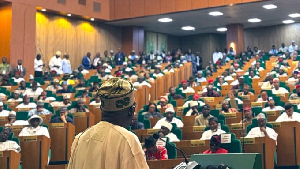
The House of Representatives on Wednesday resolved to investigate the state of the $35m modular petroleum refinery in Brass, Bayelsa State.
The resolution of the House followed the adoption of a motion of urgent public importance moved by Hon. Billy Osawaru, an Edo lawmaker, at Wednesday’s plenary session.
It’s titled, ‘Motion of urgent public importance on the need to investigate the abandoned $35m modular refinery project in Brass, Bayelsa State, four years after a huge financial commitment to that effect.’
The project, a 2,000-barrel-per-day project, is being handled by the Atlantic International Refinery and Petrochemical Limited in collaboration with the Nigerian Content Development and Monitoring Board.
The modular refinery is intended to boost the nation’s crude oil production, enhance local refineries, encourage indigenous participation in content development, and create jobs in the petroleum industry.
Although construction was expected to commence in 2021, there are reports that the project has become a subject of investigation by the Economic and Financial Crimes Commission for alleged fraudulent practices.
In 2020, the NCDMB invested $35m in the project, but according to Osawaru, “Despite this huge investment, which is more than N50bn and enough to fund fundamental components of the national budget, the proposed modular refinery that was to be known as Atlantic International Refinery and Petrochemical Limited was never set up.
“Nothing is on the ground to show that huge financial commitments had been made.”
Drawing attention to the substance of the motion, Osawaru, who represents the Orhionmwon/Uhunmwode Federal Constituency, Edo State, recalled that the House had initiated a patriotic move to unravel the mystery behind the wastage by mandating the relevant committee to investigate this monumental economic sabotage.
He lamented that despite these moves, “Nothing has been heard in respect of the subject matter.”
He continued, “In May 2024, a stakeholder submitted a petition to the EFCC urging the anti-graft organisation to probe the multi-million-dollar investments made by the NCDMB, among which was the Atlantic Refinery project.
“Despite this noble move by the said stakeholder, nothing has been heard about this profound national waste from almost a year ago.
“We are worried that the continued inactivity of this Brass modular refinery project raises significant questions about the management of public funds and the effectiveness of oversight mechanisms in Nigeria.”
The motion, when put to a voice vote by the Deputy Speaker Benjamin Kalu, who presided over Wednesday’s plenary, was overwhelmingly supported by the lawmakers.
Consequently, the House referred the motion to its Committees on Petroleum Resources (Downstream and Midstream) for further legislative action.
The committees have four weeks to submit their report to the House.

Breaking News
BREAKING NEWS: Future Leaders Must Choose Service Over Power – Wike At UNIPORT Lecture
Federal Capital Territory Minister, Nyesom Wike has urged Nigerian youths to embrace leadership as a platform for service rather than personal enrichment.
Speaking at the 36th Convocation of the University of Port Harcourt, Wike told graduating students that Nigeria’s future depends on leaders who prioritise public interest above personal gain.
“Leadership is service. It is not an avenue for self-glorification, but a covenant with the people,” he said.
The minister warned that corruption, abuse of office and self-interest have weakened institutions and slowed national development.
He challenged the graduates to become leaders defined by courage, integrity and accountability.
“The true leader does not ask, ‘What do I gain from this office?’ but rather, ‘What do the people gain from my stewardship?’” Wike stated.
According to him, leadership should be measured by the positive impact it has on people’s lives and the institutions it leaves behind.
Business
JUST-IN : Foreign Direct Investment FDI, Drops 80% As Investors Favour Bonds
Foreign direct investment into Nigeria plunged by 80 per cent in January 2026 as foreign investors increasingly channelled funds into bonds and money market instruments, despite a sharp rise in overall capital inflows, the latest Economic Report of the Central Bank of Nigeria has shown.
The report revealed that FDI fell to $30m in January from $150m in December 2025, while foreign portfolio investment surged to $3.37bn from $940m over the same period, showing investors’ preference for debt assets over long-term productive investments.
According to the CBN, “Direct investment fell by 80.0 per cent to $0.03 billion in the review period.” The apex bank, however, noted that total capital inflow into the economy rose significantly during the month.
“The economy recorded a higher inflow of capital during the review period, driven mainly by the significant increase in portfolio investment inflow,” the report stated.
Overall capital importation climbed to $3.52bn in January 2026, compared with $1.25bn recorded in December 2025, largely on the back of increased foreign participation in the domestic fixed-income market.
The report stated that foreign portfolio investment accounted for $3.37bn of the total inflow. “A disaggregation showed that inflow of foreign portfolio investment amounted to $3.37 billion, a surge from the $0.94 billion in December 2025, due to significantly higher inflows for the purchase of bonds and money market instruments,” the CBN said.
Further analysis showed that portfolio investment accounted for 95.72 per cent of total capital inflows during the review period, while direct investment contributed only 0.77 per cent.
Other investment, consisting mainly of loans, accounted for 3.51 per cent of total inflows and declined to $120m from $160m in the preceding month.
The figures suggest that while foreign investors are returning to Nigeria’s financial markets, particularly attracted by high yields on fixed-income securities, appetite for long-term investments in factories, infrastructure, and other productive ventures remains subdued.
Sectoral analysis in the report showed that the banking industry was the biggest beneficiary of foreign capital inflows, attracting 75.15 per cent of the total funds imported into the economy in January.
Related News
Tinubu’s weight-loss programme three years later
Personal loans hit N1.96tn as consumer credit grows
Women dairy farmers key to food security, livestock growth – FG
Financing activities accounted for 22.20 per cent of total inflows, while production and manufacturing received just 1.16 per cent. Investments in shares accounted for 0.76 per cent, with trading and other sectors making up the balance.
The development came amid improved performance in Nigeria’s external sector. The CBN reported that the country recorded a stronger trade position during the review period, supported by higher export earnings and sustained capital inflows.
External reserves rose to $48.88bn in January 2026, providing import cover of 8.93 months for goods and services. The naira also appreciated by 2.43 per cent at the Nigerian Foreign Exchange Market to N1,416.52/$ from the level recorded in the preceding month.
The report suggests that although macroeconomic conditions and foreign exchange stability have encouraged increased foreign participation in Nigeria’s financial markets, investors continue to favour liquid debt instruments over long-term commitments in the real sector of the economy.
President Bola Tinubu earlier said Nigeria is on course to attract close to $20bn in foreign direct investment in 2026 alone. He attributed the figure to his administration’s systematic removal of regulatory bottlenecks, macroeconomic stabilisation, and transparency reforms.
Tinubu said, “Removing all the bottlenecks gives you the necessary incentives for direct foreign investment into the country. This year alone, I can beat my chest that Nigeria is attracting close to $20bn in foreign direct investments.”
The PUNCH earlier reported that foreign direct investment accounted for less than four per cent of total capital imported into Nigeria in 2025, despite a significant increase in overall foreign inflows.
Data from the National Bureau of Statistics indicated that total capital importation rose to $23.22bn in 2025 from $12.32bn recorded in 2024, reflecting a strong rise in foreign inflows during the year. However, FDI contributed only $923.01m, representing 3.97 per cent of the total.
This compares with $674.71m recorded in 2024, when FDI accounted for 5.48 per cent of total inflows, showing that although FDI grew by $248.30m year on year, its share declined as other investment categories expanded at a faster pace.
-
Breaking News7 months agoEx-EFCC Exhibit Keeper Kaduna Zonal Directorate, Allegedly Steals ₦22m
-
Breaking News6 months agoTerrorists Want ₦2m ‘levy’ in Katsina Community Despite Peaceful Agreement
-
Breaking News8 months agoNiger Delta Group hails Tinubu, NUPRC for ₦373bn host community fund and 536 life-changing projects
-
Breaking News5 months agoBreaking News: Nigerian Air Force Reportedly Kills 750 Terrorists in Borno State
-
Breaking News8 months agoUCL: Osimhen Statement after Galatasaray’s 3-1 Win over Bodo/Glimt
-
Breaking News7 months agoBreaking: Robbery Suspects Caught After Leaving Phone At The Scene
-
Breaking News5 months agoNasarawa Insecurity: Suspects Apprehended, Man Hunt Ongoing – Gov Sule
-
Business1 month agoBREAKING NEWS: Zenith Bank Rewards Investors with ₦410.69bn Dividend at AGM