
Breaking News
AG Federation Supports Ex-lawmakers in Asking Court to Deregister ADC, Accord Party, Three Other Parties

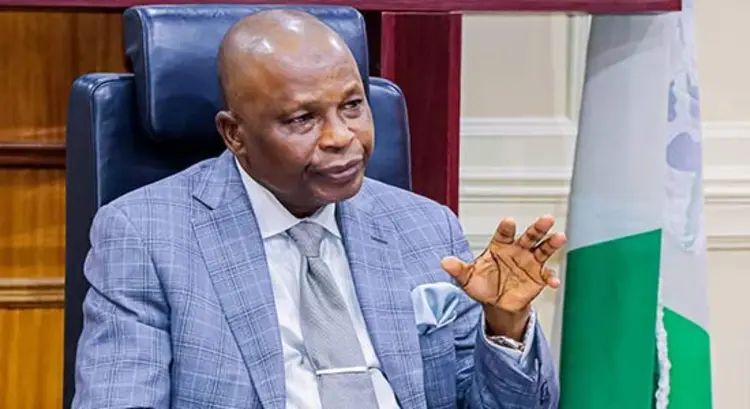
The bid by the Forum of former Legislators to compel the Independent National Electoral Commission, INEC, to deregister five political parties has received a boost with the Attorney General of the Federation and Minister of Justice AGF joining the group in the legal battle.
Although the AGF is a defendant in the suit against the African Democratic Congress ADC, the Accord Party and three others, the AGF in a dramatic turn at the Federal High Court in Abuja, pitched tents with the former legislators in pushing for the scrapping of the affected parties before the 2027 general elections.
The Minister predicated his position on the argument that the continued existence of ADC, Accord Party and others violated Constitutional provisions and undermines Nigeria’s electoral integrity.
The Attorney General contended that unless the court intervenes, INEC would “continue to act in breach of its constitutional duty” by retaining parties that have failed to meet the minimum requirements prescribed by law.
In the process filed before the court, AGF stressed that the right to associate as a political party is not absolute and must be exercised within constitutional limits.
The Minister further argued that it is in the interest of justice for the court to grant the reliefs sought by the plaintiffs.
The suit, marked FHC/ABJ/CS/2637/2026 and filed at the Abuja Judicial Division of the Federal High Court, lists the Incorporated Trustees of the National Forum of Former Legislators as the sole plaintiff.
The defendants include INEC as the first defendant and the Attorney General of the Federation as the second defendant, alongside five political parties: African Democratic Congress (ADC), Action Alliance (AA), Action Peoples Party (APP), Accord (A), and Zenith Labour Party (ZLP).
At the center of the issue in the case is whether INEC has a constitutional obligation to remove parties that fail to meet electoral performance thresholds set out in Section 225A of the 1999 Constitution (as amended) and reinforced by the Electoral Act 2022 and INEC’s own regulations.
The plaintiffs argued that the affected parties have persistently failed to satisfy the constitutional benchmarks required to retain their registration. These include winning at least 25 per cent of votes in a state during a presidential election or securing at least one elective seat at the national, state or local government level.
They contended that the parties performed poorly in the 2023 general elections and subsequent by-elections, failing to win seats across key tiers of government, yet continue to be recognised by INEC as eligible political platforms.
The plaintiffs maintained that the continued recognition is unlawful and undermines the integrity of Nigeria’s electoral system.
In the affidavit supporting the suit, the forum’s National Coordinator, Igbokwe Raphael Nnanna, stated that allowing parties that have not met constitutional requirements to remain on the register “is unconstitutional, illegal and a violation” of the governing legal framework.
The suit asked the court to declare that INEC is duty-bound to deregister such parties and to compel the commission to do so before preparations for the 2027 elections advance further.
Beyond declaratory reliefs, the plaintiffs are also seeking far-reaching orders that would bar the affected parties from participating in the next general elections or engaging in political activities such as campaigns, rallies and primaries. They further request injunctions restraining INEC from recognising or dealing with the parties in any official capacity unless and until they comply strictly with constitutional provisions.
Central to the plaintiffs’ argument is their interpretation of the law as imposing a mandatory duty on INEC. They argue that the use of the word “shall” in the Constitution leaves no room for discretion once a party fails to meet the stipulated thresholds.
In their written address, they rely on statutory provisions and judicial precedents to contend that electoral performance is an objective condition that must be enforced to maintain discipline, transparency, and accountability in the political system.
Meanwhile, in a notice filed pursuant to Order 15 Rule 1 of the Federal High Court (Civil Procedure) Rules, 2019, the Attorney General, who is a defendant in the suit, formally admitted the plaintiff’s case to the extent of his constitutional responsibilities.
He maintained that, as the chief law officer of the federation, he is duty-bound to defend and uphold the Constitution, including ensuring compliance with the Electoral Act and other laws governing elections in Nigeria.
The filing emphasised that the Attorney General’s role extends beyond litigation to preventive oversight, ensuring that laws are faithfully implemented to maintain public confidence in the electoral process. It described the case as a public interest litigation aimed at safeguarding democratic integrity and promoting constitutional observance.
According to the document, the Attorney General argued that citizens, including the plaintiff group, have the right to challenge constitutional breaches, particularly where electoral processes are concerned. He added that supporting such litigation aligns with his dual role as both a defender of the state and an advocate for citizens’ rights.
The submission also highlighted the broader implications of non-compliance by political parties. It argued that the continued existence of parties that fail to meet constitutional thresholds contributes to ballot congestion, increases the cost of election administration, and undermines the intent of Section 225A of the 1999 Constitution (as amended), which empowers INEC to deregister underperforming parties.
The plaintiff further contended that INEC has no residual discretion to retain parties that do not satisfy the constitutional criteria, insisting that failure to deregister them constitutes a continuing breach of constitutional duty. The suit warned that such inaction could be challenged through public interest litigation, as is the case before the court.
Additionally, the filing noted that the plaintiff, comprising former legislators, possesses the requisite standing to institute the action, having been directly involved in the enactment and oversight of Nigeria’s constitutional and electoral framework.
The Attorney General also underscored the importance of access to justice, arguing that his support for the suit would help bridge gaps faced by citizens seeking to enforce constitutional rights. He maintained that collaboration between government institutions and civic actors is essential to strengthening legal literacy, accountability, and democratic participation.
The Attorney General of the Federation is represented in the suit by a team of lawyers led by Prof. Joshua Olatoke, SAN, alongside O. J. David, U. O. Olufadi, D. O. Bamidele, V. D. Maiye, Waheed Abdulraheem and A. K. Abdulmumin, all of whom signed the court filing before the Federal High Court in Abuja.
Breaking News
BUNKERING: Troops Uncover Suspected Illegal Refinery In Rivers, Recover Crude Oil Processing Equipment
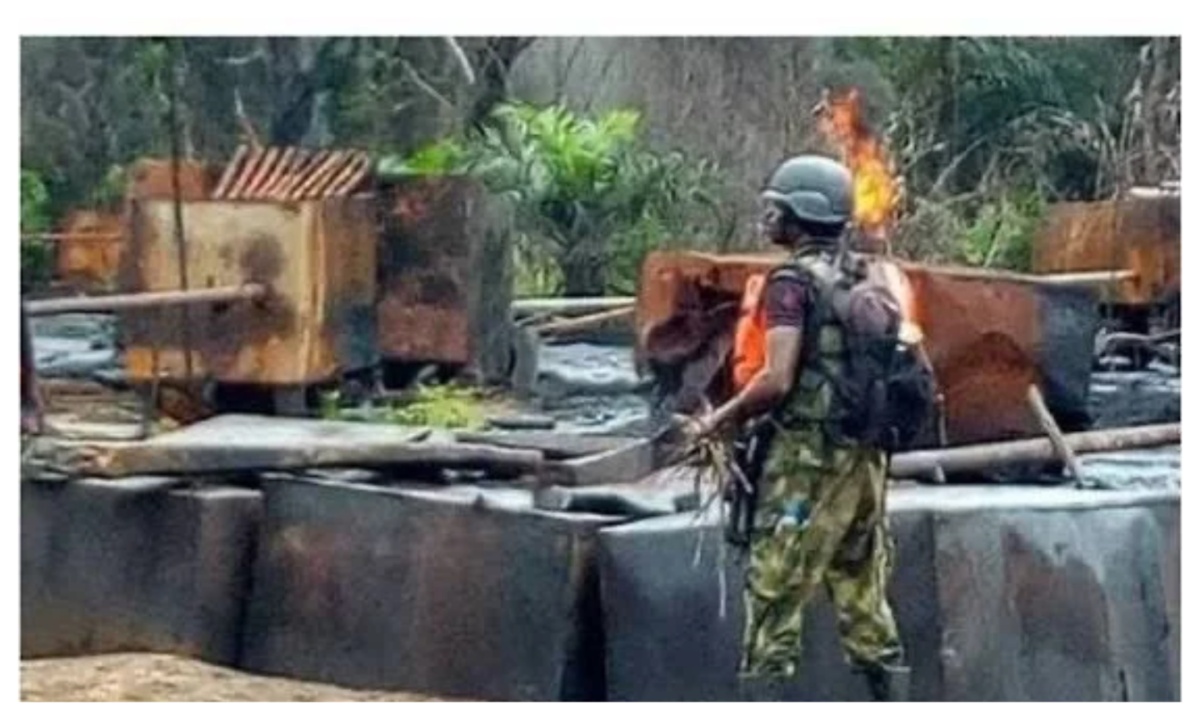
Troops have uncovered suspected illegal crude oil refining equipment during a patrol operation in the Orashi National Forest, Ahoada West Local Government Area of Rivers State.
The development was disclosed in a report by Zagazola Makama, a counter-insurgency and security expert covering the Lake Chad region.
According to the report, the discovery was made at about 12:00pm on Saturday by troops of the 16 Brigade Garrison at Abissa in collaboration with personnel of the 5 Battalion while carrying out anti-crude oil theft operations.
Makama reported that the troops discovered equipment believed to have been used for suspected illegal crude oil refining activities during the patrol.
Items recovered from the site included one large oven drum, one large coolant, two small oven drums, one small coolant, one long galvanised pipe and two sacks containing crude oil.
Makama said the recovered items were handled in line with the operational procedures guiding the ongoing anti-crude oil theft operations.
“The operation forms part of sustained efforts by security forces to dismantle illegal refining camps, curb crude oil theft and protect critical national assets in the Niger Delta region,” the report stated. …For more, Complete your reading.
You may like

A Nigerian-American engineer, Anthony Ehiedu Ugbebor, has asked the Court of Appeal to overturn the judgment of the Lagos High Court which declared that his property purchase agreement with a developer, Mr Olukayode Olusanya and Oak Homes Multinational Services Limited had been extinguished by the doctrine of novation.
The Lagos High Court had in the judgment ordered the refund of the N152 million Ugbebor paid for two luxury apartments in Victoria Island, Lagos.
In a Notice of Appeal filed by his counsel, Barrister Nasir Salau of Nasir Salau & Co., challenging the June 15, 2026 judgment delivered by Justice Akingbola George, Ugbebor argued that the trial judge misapplied settled principles of contract law, ignored material evidence, wrongly dismissed his counterclaim, and erroneously refused his claim for specific performance of the property sale agreement.
The appeal arose from Suit No. LD/4471LM/2023, instituted by property developer Olukayode Olusanya and Oak Homes against Ugbebor and the Economic and Financial Crimes Commission, EFCC, over alleged trespass on two second-floor three-bedroom apartments located at 14A Musa Yar’Adua Street, Victoria Island, Lagos.
Although the Lagos High Court dismissed most of the developer’s claims, it held that the parties’ conduct had effectively terminated their original agreement through novation.
The court also ordered Olukayode and Oak Homes to refund the N152 million previously paid by Ugbebor, while dismissing the engineer’s counterclaim seeking completion and delivery of the apartments or, alternatively, damages.
Dissatisfied with those findings, Ugbebor asked the Court of Appeal to overturn the judgment, restore the validity of the original contract and compel Oak Homes to honour its obligations under the agreement
Ugbebor also urged the appellate court to set aside the judgment in its entirety, arguing that the Lagos High Court’s findings were contrary to the evidence and established legal principles governing contracts.
He maintained that the original agreement remained valid and enforceable and asked the Court of Appeal to compel Oak Homes to honour its contractual obligations.
One of his principal complaints is that the trial judge wrongly placed the burden of proving payment on him instead of the claimant.
According to the Notice of Appeal, the judge erred in holding that he failed to make payments within contractual timelines despite evidence that the payment structure under the agreement was tied to construction milestones rather than fixed dates.
The appellant argued that under the payment schedule contained in Exhibit CW1, 35 percent of the purchase price became payable upon completion of the roofing stage, while the final 20 per cent became payable only upon completion of the apartments.
He maintained that the agreement never required payment on fixed calendar dates and that he had already paid about 80 per cent of the agreed purchase price even though the developer allegedly failed to attain the contractual milestones.
According to him, the trial judge misconstrued the payment clauses and ignored the unchallenged testimony of the defence witness that substantial payments had been made despite the developer’s inability to complete the project as agreed.
He further argued that under the Evidence Act, the burden of proving non-payment rested on Oak Homes, which alleged breach of contract, and not on him.
A major plank of the appeal is the trial court’s reliance on the doctrine of novation.
Justice George had held that the conduct of both parties created a new contractual relationship which effectively extinguished the original agreement.
However, Ugbebor argued that the finding was contrary to established principles of Nigerian contract law.
Relying on the Supreme Court’s decision in Heritage Bank Ltd v. Ajugwo, he contended that novation cannot be presumed merely from the conduct of parties.
According to him, for novation to arise there must be a clear agreement by all parties to substitute the original contract with a new one, coupled with an intention to extinguish the previous contractual obligations.
He argued that no witness testified that such a new agreement existed and no documentary evidence established one.
Rather, he maintained that the conduct relied upon by the trial court was consistent only with issues of delayed performance and alleged breach, not the creation of an entirely new contract.
He therefore urged the Court of Appeal to hold that the original agreement remained valid and binding. …For more, Complete your reading.
You may like
-

 Breaking News7 months ago
Terrorists Want ₦2m ‘levy’ in Katsina Community Despite Peaceful Agreement
-

 Breaking News8 months ago
Ex-EFCC Exhibit Keeper Kaduna Zonal Directorate, Allegedly Steals ₦22m
-

 Breaking News9 months ago
Niger Delta Group hails Tinubu, NUPRC for ₦373bn host community fund and 536 life-changing projects
-

 Breaking News7 months ago
Breaking News: Nigerian Air Force Reportedly Kills 750 Terrorists in Borno State
-

 Business9 months ago
House of Representatives probes $35m modular refinery project
-

 Breaking News9 months ago
UCL: Osimhen Statement after Galatasaray’s 3-1 Win over Bodo/Glimt
-

 Business2 months ago
BREAKING NEWS: Zenith Bank Rewards Investors with ₦410.69bn Dividend at AGM
-

 Breaking News6 months ago
Nasarawa Insecurity: Suspects Apprehended, Man Hunt Ongoing – Gov Sule