
Business
Traders Grievous, Protest Market Closure in Anambra State

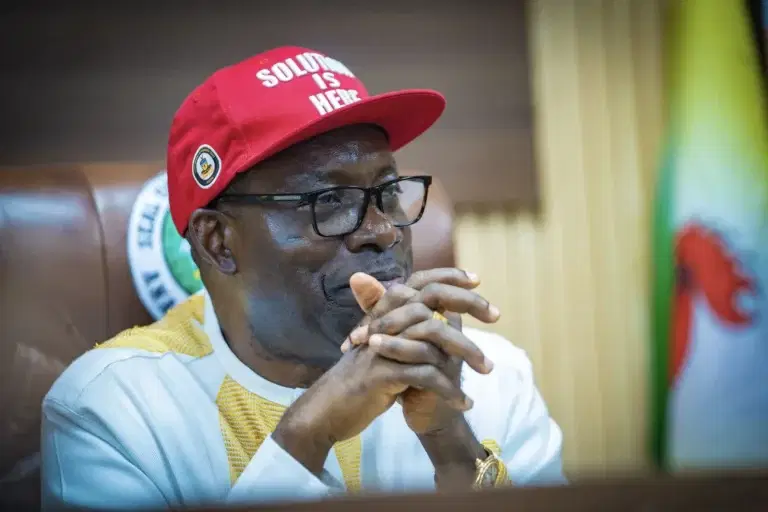
Tension gripped Onitsha, the commercial hub of Anambra State, yesterday, following the continued closure of the Onitsha Main Market and its adjoining markets, as traders protested the enforcement of Governor Chukwuma Soludo’s directive, ordering markets to operate on Mondays.
Heavy security presence, comprising soldiers, police officers and operatives of Operation Udo-Ga-Achi (Agunechemba), took over all entry and exit points to the Onitsha Main Market as early as 6:30 a.m., effectively preventing traders from accessing their shops.
The closure affected several adjoining markets, including Marine Market, Biafra Market, Kano Street Market, Sokoto Road Market, William Street Market and Bida Road Market, all of which depend on the Main Market for daily commercial activities.
The market shutdown is part of Governor Soludo’s enforcement measures against the continued observance of Monday sit-at-home in the South-East, which the state government has described as economic sabotage.
However, the move triggered anger among traders who attempted to defy the order and force their way into the market but were stopped by armed security personnel and ordered to vacate the area.
During visits by journalists, groups of traders were seen chanting protest songs, pleading with the governor to lift the ban, while others loitered around the market environment, hoping for a last-minute reversal. After several hours, many traders dispersed and returned home when it became clear that the order would not be lifted.
Some traders accused the governor of acting high-handedly, alleging that the same level of security deployed to enforce the market closure had never been provided to protect traders from attacks by criminal elements enforcing sit-at-home orders in previous years.
A trader, Tobechukwu Ezeh, described the market closure as “executive rascality and recklessness,” alleging that traders and market leaders had suffered kidnappings and killings in 2024 and 2025 for attempting to resume Monday trading without adequate government protection.
According to him, a market leader at the Old Motor Spare Parts Market, Obosi, popularly known as Ngbuka Obosi Market, was abducted last year and has yet to be found, without any meaningful intervention from the state government.
“Security men we are seeing today were never here when traders were being attacked. Now they are everywhere to stop us from entering our markets. If this level of security had been provided on Mondays, we would not be here today,” Ezeh said.
Another trader, a 70-year-old man who identified himself as Eugen, blamed the decline in traders’ influence on successive state administrations, accusing them of imposing market leadership structures that weakened traders’ collective bargaining power.
He lamented that traders lost their voice after the administration of former Governor Chinweoke Mbadinuju, alleging that government interference and internal divisions among traders’ associations made them vulnerable to exploitation and policy imposition.
Meanwhile, the Igbo Community Association, Abuja, has called on Governor Soludo to urgently reopen the Onitsha Main Market to prevent the escalation of protests and a possible breakdown of law and order.
In a statement jointly signed by its President General, Engr. Ikenna Ellis-Ezenekwe, and Secretary General, Mazi Emmanuel Onah, the association expressed concern that protests by traders were already spreading and could spiral into violence if the markets remained closed.
The group warned that continued closure could lead to injuries, loss of lives and destruction of property, stressing the need to respect democratic principles and citizens’ rights to peaceful protest.
“We urge the governor to listen to the voices of the people and work towards a peaceful resolution. The markets are a vital part of the community’s economic and social fabric, and their closure has caused hardship to traders and consumers alike,” the statement said.
While calling for the immediate reopening of the markets, the association also commended Governor Soludo for his efforts to tackle economic sabotage and acknowledged his achievements in infrastructure development and policy implementation across the state.
“We recognise the governor’s commitment to economic development and his notable strides in governance.”
However, the voice of the people must be heard and respected. We want dialogue and harmonious engagement, not brute force,” the group added.
As of press time, security remained tight around the Onitsha markets, with traders staying away amid fears of further confrontation, while calls for dialogue and de-escalation continued to mount.
Breaking News
BREAKING NEWS: Future Leaders Must Choose Service Over Power – Wike At UNIPORT Lecture
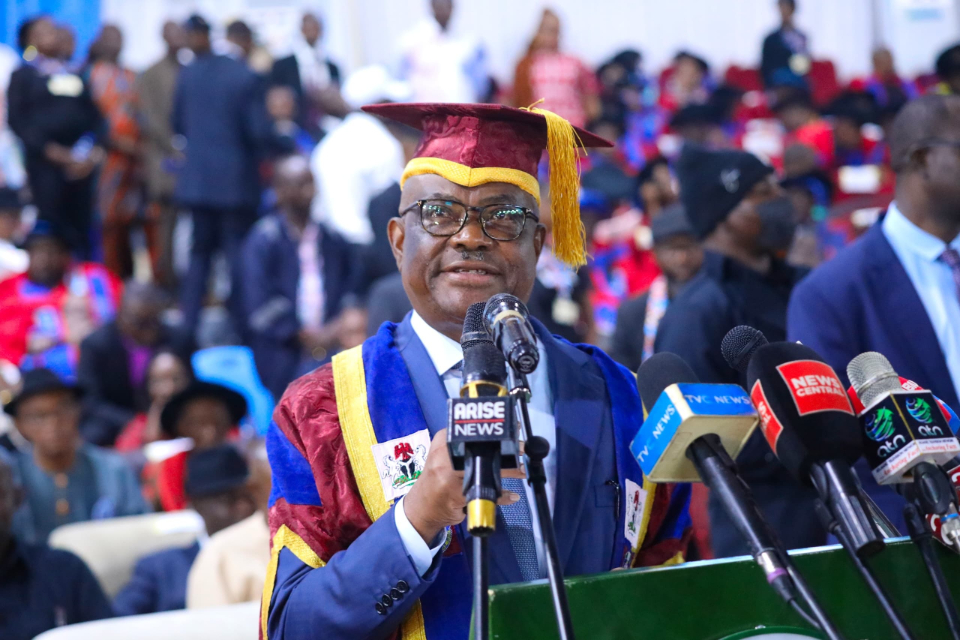
Federal Capital Territory Minister, Nyesom Wike has urged Nigerian youths to embrace leadership as a platform for service rather than personal enrichment.
Speaking at the 36th Convocation of the University of Port Harcourt, Wike told graduating students that Nigeria’s future depends on leaders who prioritise public interest above personal gain.
“Leadership is service. It is not an avenue for self-glorification, but a covenant with the people,” he said.
The minister warned that corruption, abuse of office and self-interest have weakened institutions and slowed national development.
He challenged the graduates to become leaders defined by courage, integrity and accountability.
“The true leader does not ask, ‘What do I gain from this office?’ but rather, ‘What do the people gain from my stewardship?’” Wike stated.
According to him, leadership should be measured by the positive impact it has on people’s lives and the institutions it leaves behind.
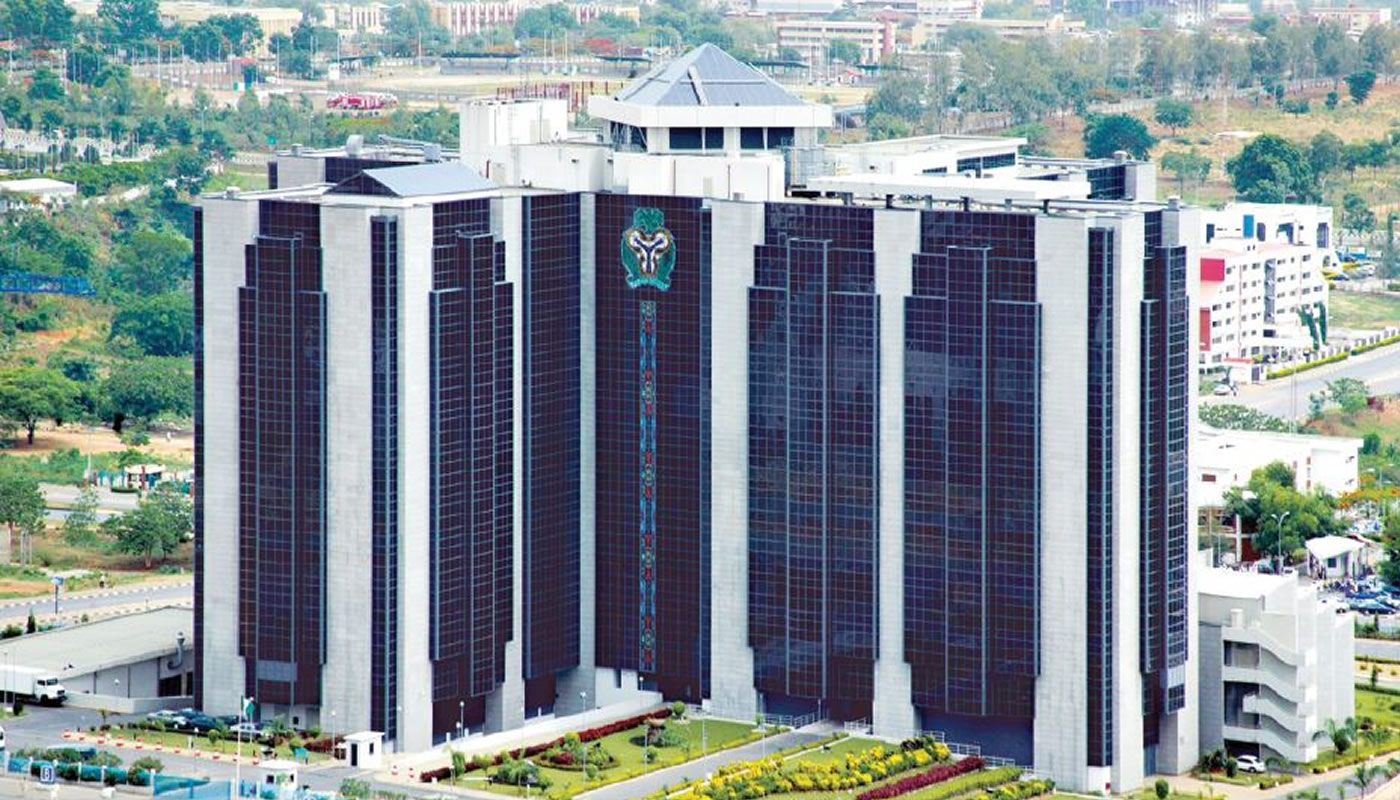
Foreign direct investment into Nigeria plunged by 80 per cent in January 2026 as foreign investors increasingly channelled funds into bonds and money market instruments, despite a sharp rise in overall capital inflows, the latest Economic Report of the Central Bank of Nigeria has shown.
The report revealed that FDI fell to $30m in January from $150m in December 2025, while foreign portfolio investment surged to $3.37bn from $940m over the same period, showing investors’ preference for debt assets over long-term productive investments.
According to the CBN, “Direct investment fell by 80.0 per cent to $0.03 billion in the review period.” The apex bank, however, noted that total capital inflow into the economy rose significantly during the month.
“The economy recorded a higher inflow of capital during the review period, driven mainly by the significant increase in portfolio investment inflow,” the report stated.
Overall capital importation climbed to $3.52bn in January 2026, compared with $1.25bn recorded in December 2025, largely on the back of increased foreign participation in the domestic fixed-income market.
The report stated that foreign portfolio investment accounted for $3.37bn of the total inflow. “A disaggregation showed that inflow of foreign portfolio investment amounted to $3.37 billion, a surge from the $0.94 billion in December 2025, due to significantly higher inflows for the purchase of bonds and money market instruments,” the CBN said.
Further analysis showed that portfolio investment accounted for 95.72 per cent of total capital inflows during the review period, while direct investment contributed only 0.77 per cent.
Other investment, consisting mainly of loans, accounted for 3.51 per cent of total inflows and declined to $120m from $160m in the preceding month.
The figures suggest that while foreign investors are returning to Nigeria’s financial markets, particularly attracted by high yields on fixed-income securities, appetite for long-term investments in factories, infrastructure, and other productive ventures remains subdued.
Sectoral analysis in the report showed that the banking industry was the biggest beneficiary of foreign capital inflows, attracting 75.15 per cent of the total funds imported into the economy in January.
Related News
Tinubu’s weight-loss programme three years later
Personal loans hit N1.96tn as consumer credit grows
Women dairy farmers key to food security, livestock growth – FG
Financing activities accounted for 22.20 per cent of total inflows, while production and manufacturing received just 1.16 per cent. Investments in shares accounted for 0.76 per cent, with trading and other sectors making up the balance.
The development came amid improved performance in Nigeria’s external sector. The CBN reported that the country recorded a stronger trade position during the review period, supported by higher export earnings and sustained capital inflows.
External reserves rose to $48.88bn in January 2026, providing import cover of 8.93 months for goods and services. The naira also appreciated by 2.43 per cent at the Nigerian Foreign Exchange Market to N1,416.52/$ from the level recorded in the preceding month.
The report suggests that although macroeconomic conditions and foreign exchange stability have encouraged increased foreign participation in Nigeria’s financial markets, investors continue to favour liquid debt instruments over long-term commitments in the real sector of the economy.
President Bola Tinubu earlier said Nigeria is on course to attract close to $20bn in foreign direct investment in 2026 alone. He attributed the figure to his administration’s systematic removal of regulatory bottlenecks, macroeconomic stabilisation, and transparency reforms.
Tinubu said, “Removing all the bottlenecks gives you the necessary incentives for direct foreign investment into the country. This year alone, I can beat my chest that Nigeria is attracting close to $20bn in foreign direct investments.”
The PUNCH earlier reported that foreign direct investment accounted for less than four per cent of total capital imported into Nigeria in 2025, despite a significant increase in overall foreign inflows.
Data from the National Bureau of Statistics indicated that total capital importation rose to $23.22bn in 2025 from $12.32bn recorded in 2024, reflecting a strong rise in foreign inflows during the year. However, FDI contributed only $923.01m, representing 3.97 per cent of the total.
This compares with $674.71m recorded in 2024, when FDI accounted for 5.48 per cent of total inflows, showing that although FDI grew by $248.30m year on year, its share declined as other investment categories expanded at a faster pace.
-

 Breaking News7 months ago
Ex-EFCC Exhibit Keeper Kaduna Zonal Directorate, Allegedly Steals ₦22m
-

 Breaking News6 months ago
Terrorists Want ₦2m ‘levy’ in Katsina Community Despite Peaceful Agreement
-

 Breaking News8 months ago
Niger Delta Group hails Tinubu, NUPRC for ₦373bn host community fund and 536 life-changing projects
-

 Breaking News5 months ago
Breaking News: Nigerian Air Force Reportedly Kills 750 Terrorists in Borno State
-

 Business8 months ago
House of Representatives probes $35m modular refinery project
-

 Breaking News8 months ago
UCL: Osimhen Statement after Galatasaray’s 3-1 Win over Bodo/Glimt
-

 Breaking News7 months ago
Breaking: Robbery Suspects Caught After Leaving Phone At The Scene
-

 Breaking News5 months ago
Nasarawa Insecurity: Suspects Apprehended, Man Hunt Ongoing – Gov Sule