
Breaking News
Breaking News: “U.S. Surveillance Aircraft Entered Nigerian Airspace Over ISWAP Territory”


Brant Philip, a Sahel-focused terrorism tracker, has sparked heightened scrutiny of U.S.–Nigeria security cooperation after alleging that American surveillance aircraft have now entered Nigerian airspace, days after earlier reports suggested the United States may be preparing for unmanned drone strikes against terrorist targets inside the country.
In a series of posts on X, Philip said that a manned U.S. intelligence, surveillance and reconnaissance aircraft flew on Saturday over Islamic State West Africa Province strongholds near the southwestern shores of Lake Chad in Borno State. He claimed the aircraft departed from Accra, Ghana.
“Confirming my earlier reports, a manned U.S. ISR aircraft was conducting reconnaissance earlier today over ISWAP territory,” he wrote, a statement that immediately fueled intense online debate.
By Sunday, Philip reported that the same aircraft had returned for a third consecutive day, circling repeatedly over ISWAP’s enclave known as Mantiqah Krinwa on the fringes of Lake Chad.
His claims came after an earlier allegation, based on a source he cited, that the United States is preparing to conduct UAV strikes inside Nigeria under a new but undisclosed security arrangement. According to that report, the agreement would permit only unmanned aircraft for kinetic operations, ruling out the deployment of American fighter jets or bombers.
The unnamed source also alleged that the U.S. military’s main role would be to close intelligence, surveillance and reconnaissance gaps for Nigerian forces using both unmanned and manned platforms. Kainji Air Base in Niger State, where Nigeria’s A-29 Super Tucanos are based, was mentioned as a possible site for supporting U.S. operations, though no official confirmation exists.
Philip further claimed that the U.S. Department of Defence, which he referred to as the Department of War, has already initiated reconnaissance missions from American facilities in Ghana, flying into Nigerian airspace without public disclosure by the Nigerian government.
His assertions quickly drew criticism. Former presidential aide Bashir Ahmad accused him of recklessly publicizing sensitive operational movements that could benefit ISWAP fighters.
The controversy escalates days after U.S. Secretary of War Pete Hegseth held high-level security talks in Washington with Nigeria’s National Security Adviser, Mallam Nuhu Ribadu, focusing on terrorism and rising attacks on Christian communities.
Despite growing speculation, neither the Nigerian government nor the United States has issued any confirmation or denial regarding American ISR flights or potential drone-strike preparations.
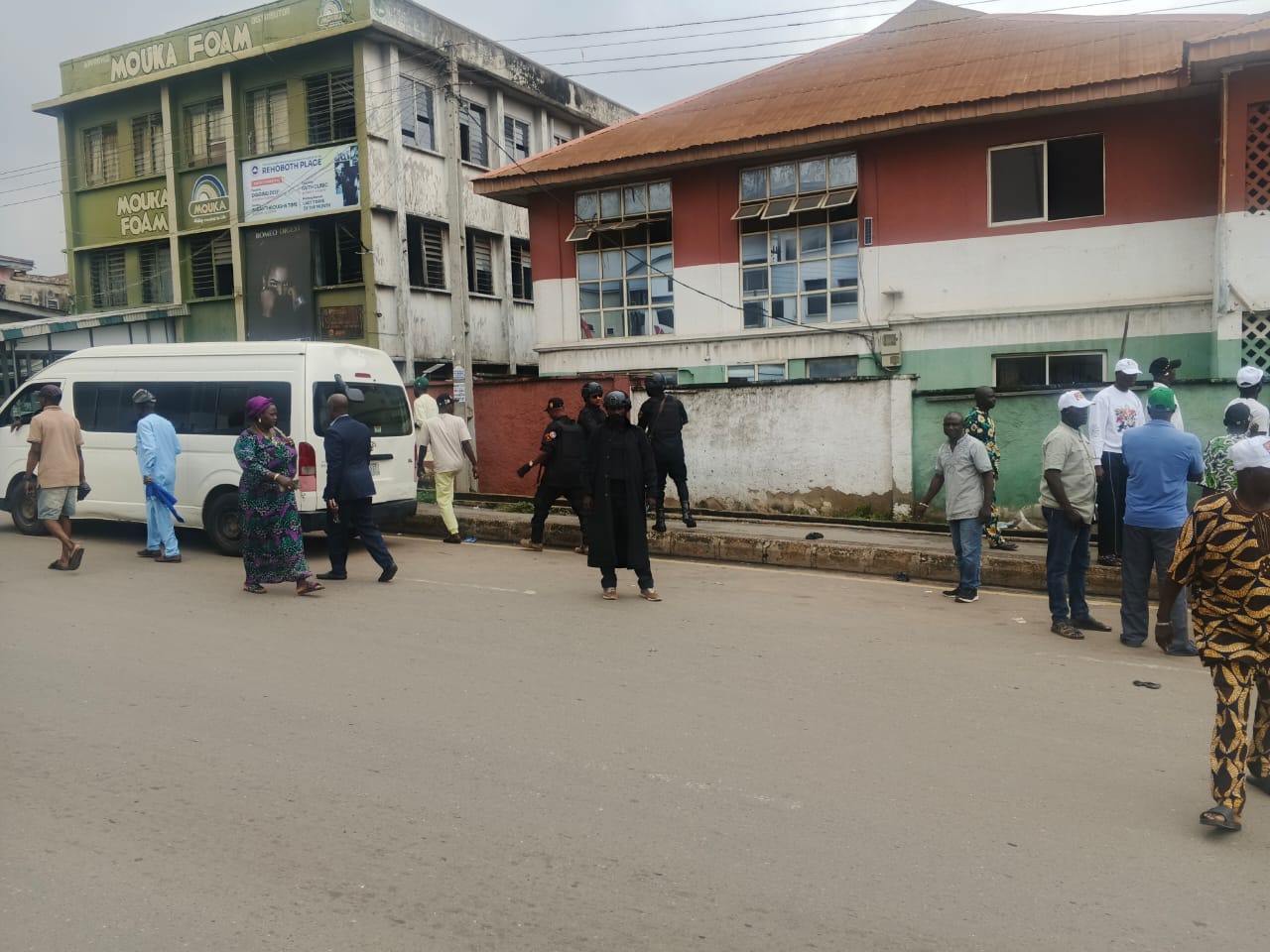
Members of Peoples Democratic Party, PDP, loyal to the Minister of Federal Capital Territory, FCT, Nyesom Wike, have taken over the secretariat of the party in Oyo State.
The secretariat, located in the Molete area of Ibadan, was in the custody of the faction loyal to Governor Seyi Makinde of the state until Thursday when the members loyal to Wike took over the premises.
DAILY POST gathered that the PDP members stormed the secretariat on Thursday and occupied the premises with hundreds of members of the party in attendance.
PDP chairman in the state, Professor Abdulrahman Akinoso, confirmed the development to DAILY POST.
Akinoso in a telephone conversation with DAILY POST on Thursday, insisted that the real owners have taken over the premises.
He said, “It is true. It is not faction. It is PDP. We have taken over the premises. It was in the morning. We were there in the morning. We just left the premises. We are now in control. We have taken over the premises.” .…For more, Complete your reading.

The African Democratic Congress (ADC) has told President Bola Tinubu that foreign recognition will not secure him another term in office, insisting that Nigerians will judge his administration by its performance, not by diplomatic gestures from other world leaders.
In a statement issued on Thursday by its National Publicity Secretary, Bolaji Abdullahi, the opposition party reacted to the Presidency’s celebration of a purported letter from United States President Donald Trump to Tinubu.
The ADC said presenting the letter as an endorsement of Tinubu’s administration was misleading, stressing that diplomatic correspondence between world leaders is a normal part of international relations.
“The Presidency’s attempt to present President Donald Trump’s letter to President Bola Ahmed Tinubu as though it were a referendum on the state of the nation is not correct,” the party said.
According to the ADC, countries cooperate, leaders exchange views and letters regularly, adding that such communication does not amount to an endorsement of a government’s performance.
The party accused the Tinubu administration of being desperate for international validation instead of focusing on solving Nigeria’s challenges.
“It is apparent that this administration is desperate to seize upon any gesture of international recognition as proof of success at home,” the statement said.
The ADC maintained that “a letter from a foreign president, however well-intentioned, cannot substitute for the verdict of the Nigerian people.”
It added that the true measure of any government is not what foreign leaders say about it, but what citizens experience daily.
The opposition party argued that Trump’s letter had not changed the reality facing millions of Nigerians, especially those affected by insecurity.
“For the millions of Nigerians still living with the consequences of this government’s failures, President Trump’s communication changes nothing. It did not say that insecurity has been overcome or that Nigerians can once again travel freely, farm safely and sleep without fear,” the party stated.
The ADC also pointed to the continued captivity of hundreds of women and children in parts of Borno State and Kaiama in Kwara State, while many communities in Benue and other parts of the country still live in constant fear because of insecurity.
The party further noted that, despite the Presidency’s celebration of the letter, the United States Department of State has not changed its travel advisory for Nigeria.
According to the ADC, several Nigerian states remain under Level 3 and Level 4 travel advisories, with American citizens still being urged to reconsider or avoid travel because of crime, terrorism, kidnapping and civil unrest.
“We therefore wonder how correspondence from a government that designates several Nigerian states as ‘Do Not Travel’ areas can be regarded as an endorsement,” the party said.
It argued that the travel advisory shows the international assessment of Nigeria’s security situation remains different from the image the Presidency is trying to project.
The ADC said Nigerians are more concerned about their safety than diplomatic exchanges between presidents.
“The daily reality of Nigerians is shaped not by diplomatic correspondence, but by the guarantee that they can go about their lives without falling victim to violent crime or terrorism,” it said.
The party stressed that Trump’s letter was simply communication between two presidents and “does not amount to an endorsement of this government’s overall performance.”
It urged the Tinubu administration to focus less on celebrating diplomatic courtesies and more on delivering measurable improvements in the lives of Nigerians.
“Ultimately, Nigerians will not judge this government by the letters it receives from foreign capitals. They will judge it by whether .…For more, Complete your reading.
-

 Breaking News8 months ago
Terrorists Want ₦2m ‘levy’ in Katsina Community Despite Peaceful Agreement
-

 Breaking News8 months ago
Ex-EFCC Exhibit Keeper Kaduna Zonal Directorate, Allegedly Steals ₦22m
-

 Breaking News9 months ago
Niger Delta Group hails Tinubu, NUPRC for ₦373bn host community fund and 536 life-changing projects
-

 Breaking News7 months ago
Breaking News: Nigerian Air Force Reportedly Kills 750 Terrorists in Borno State
-

 Business9 months ago
House of Representatives probes $35m modular refinery project
-

 Business3 months ago
BREAKING NEWS: Zenith Bank Rewards Investors with ₦410.69bn Dividend at AGM
-

 Breaking News9 months ago
UCL: Osimhen Statement after Galatasaray’s 3-1 Win over Bodo/Glimt
-

 Breaking News7 months ago
Nasarawa Insecurity: Suspects Apprehended, Man Hunt Ongoing – Gov Sule