
Breaking News
A consultant cardiologist Raises Alarm, ‘Young Nigerians face rising hypertension risk’

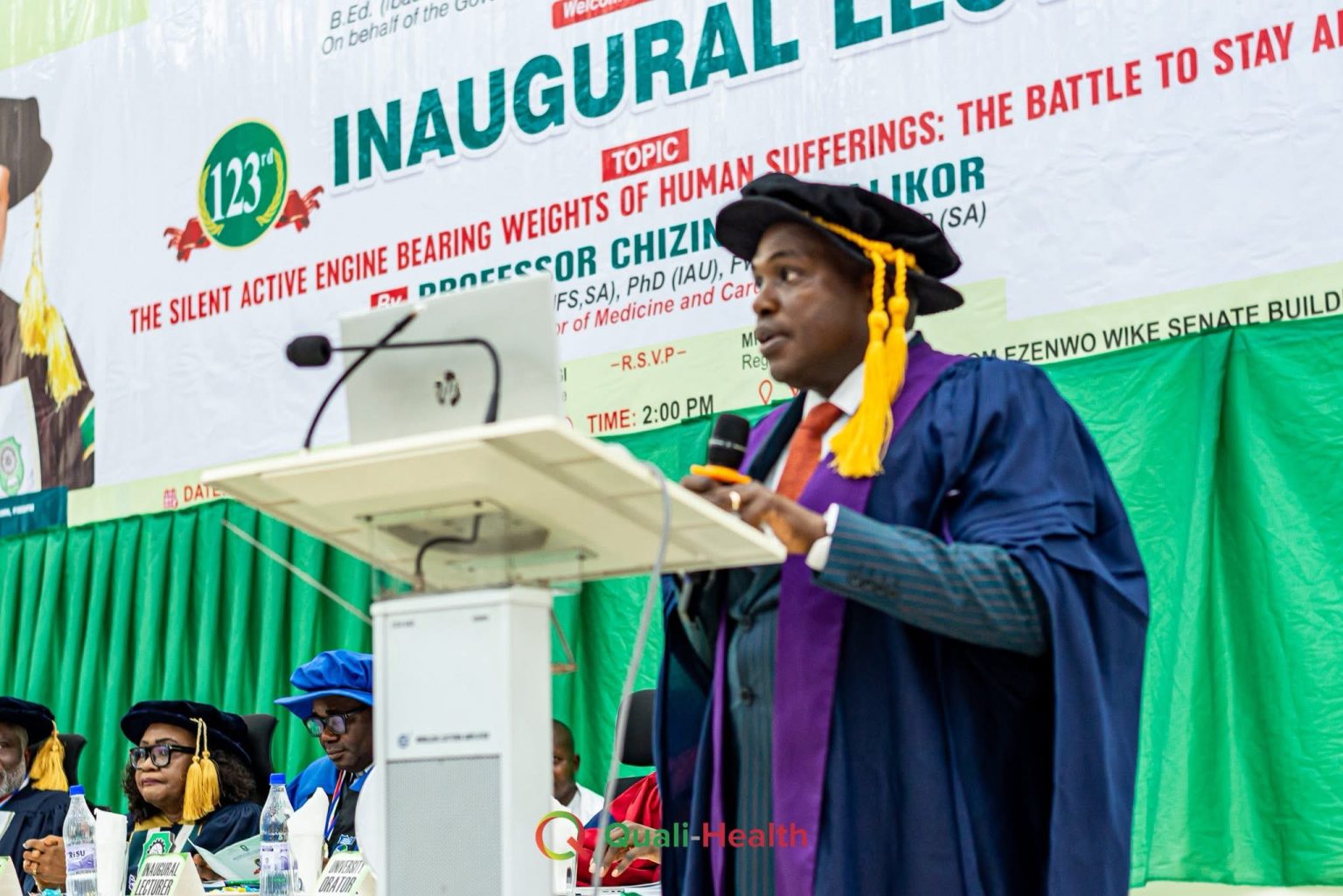
A consultant cardiologist, Professor Chizindu Alikor, has raised serious concern over the rising incidence of hypertension among young Nigerians, warning that high blood pressure is “no longer a sickness for the old” as even 18-year-olds are increasingly being diagnosed.
Professor Alikor issued the warning during the 123rd Inaugural Lecture of the Rivers State University, RSU, on Wednesday, delivering a presentation themed: “The Silent Active Engine Bearing Weights of Human Sufferings: The Battle to Stay Alive.”
Explaining the theme of his lecture, Professor Alikor, who is the Chief Medical Director at the Rivers State University Teaching Hospital, RSUTH, described the heart as “the silent active engine” that tirelessly keeps humanity alive despite enormous pressure.
He noted that lifestyle choices are now the greatest threats to heart health.
According to him, “Lifestyle decisions impact the heart,” stressing that diet, stress, excessive salt intake, high refined sugar consumption, obesity, poor diabetes management, and untreated hypertension are major contributors to the growing burden of cardiovascular diseases.
“These,” he said, “are components in the domains of suffering that impact negatively on the human heart.”
To address this, the cardiologist proposed the “Alikor Survival Network Model,” a holistic approach involving the individual, family and the healthcare system to ensure better heart care.
Rising Hypertension in Young Adults and Rural Communities
Professor Alikor, who is the President, Nigerian Society of Nuclear Medicine and Molecular Imaging also revealed findings from his research in collaboration with others conducted more than 20 years ago, showing an already high prevalence of cardiovascular risk factors in the Niger Delta.
More alarming, however, is the increasing trend of hypertension in rural communities and among young people.
He disclosed that among people aged 18 to 39, cardiovascular risk factor clustering is as high as 15%, calling the trend “worrisome.”
He also questioned what the situation might be in cities, where urbanization and changing lifestyles have eroded traditional diets and physical activity.
“Urbanization has wiped away the traditional diet and leg walk and has brought us to a sedentary lifestyle,” he said.
Professor Alikor said the research further showed that men have a higher prevalence of cardiovascular risk clusters.
Hypertension, Heart Failure and Stroke Dominating Niger Delta Cases
According to Professor Alikor, heart failure and stroke remain the most common cardiovascular complications among hospitalized patients in the Niger Delta.
He advised that symptoms such as palpitations should never be ignored, describing them as signs of cardiovascular strain that require immediate attention from a cardiologist.
The cardiologist emphasized that survival depends on shared responsibility.
“The battle to stay alive is a collective project and not an individual endeavor,” he said, insisting that the Alikor Heart Survival Network Model, when applied, can protect both individuals and communities.
He highlighted diet as the first line of defense, noting: “Diets rich in vegetables, fruits, legumes, and whole grains are useful.
“Diets high in salt, trans fat, refined sugar, are enemies of the silent active engine (the heart).”
Alikor urged Nigerians to “know your numbers, including blood pressure, blood sugar and cholesterol levels.
Alarmingly, he noted: “In our study we established that even among the very educated, they move around with 200/150, just moving around; very enlightened university professors.”
He encouraged regular home monitoring, saying: “You need to have your blood pressure monitors, the electronic ones, good ones… Keep in the office, keep by your bedsides and check your blood pressure regularly.”
Referencing scripture, he said “Luke 22:44 has cardiovascular implications,” reinforcing the physiological stress the heart endures.
Processed Foods, Decline in Physical Activity Driving Future Crisis
Professor Alikor warned that epidemiologic transition and lifestyle changes — including the shift to fast foods and processed meals — are accelerating cardiovascular risks.
He said traditional habits such as vegetable-rich diets and long walks have been abandoned due to westernization, and without intentional interventions, “in the next 10 to 20 years, there will be an alarming increase of heart attacks and stroke.”
To mitigate this looming crisis, he presented the “Alikor Health Care Survival Model.”
Earlier, the Vice Chancellor of Rivers State University, Professor Isaac Zeb-Obipi, reaffirmed the institution’s commitment to addressing societal problems through research and intellectual engagement.
He noted that issues such as poor infrastructure, unemployment, poverty and diseases are worsened by daily stress and unhealth lifestyles.

Members of Peoples Democratic Party, PDP, loyal to the Minister of Federal Capital Territory, FCT, Nyesom Wike, have taken over the secretariat of the party in Oyo State.
The secretariat, located in the Molete area of Ibadan, was in the custody of the faction loyal to Governor Seyi Makinde of the state until Thursday when the members loyal to Wike took over the premises.
DAILY POST gathered that the PDP members stormed the secretariat on Thursday and occupied the premises with hundreds of members of the party in attendance.
PDP chairman in the state, Professor Abdulrahman Akinoso, confirmed the development to DAILY POST.
Akinoso in a telephone conversation with DAILY POST on Thursday, insisted that the real owners have taken over the premises.
He said, “It is true. It is not faction. It is PDP. We have taken over the premises. It was in the morning. We were there in the morning. We just left the premises. We are now in control. We have taken over the premises.” .…For more, Complete your reading.

The African Democratic Congress (ADC) has told President Bola Tinubu that foreign recognition will not secure him another term in office, insisting that Nigerians will judge his administration by its performance, not by diplomatic gestures from other world leaders.
In a statement issued on Thursday by its National Publicity Secretary, Bolaji Abdullahi, the opposition party reacted to the Presidency’s celebration of a purported letter from United States President Donald Trump to Tinubu.
The ADC said presenting the letter as an endorsement of Tinubu’s administration was misleading, stressing that diplomatic correspondence between world leaders is a normal part of international relations.
“The Presidency’s attempt to present President Donald Trump’s letter to President Bola Ahmed Tinubu as though it were a referendum on the state of the nation is not correct,” the party said.
According to the ADC, countries cooperate, leaders exchange views and letters regularly, adding that such communication does not amount to an endorsement of a government’s performance.
The party accused the Tinubu administration of being desperate for international validation instead of focusing on solving Nigeria’s challenges.
“It is apparent that this administration is desperate to seize upon any gesture of international recognition as proof of success at home,” the statement said.
The ADC maintained that “a letter from a foreign president, however well-intentioned, cannot substitute for the verdict of the Nigerian people.”
It added that the true measure of any government is not what foreign leaders say about it, but what citizens experience daily.
The opposition party argued that Trump’s letter had not changed the reality facing millions of Nigerians, especially those affected by insecurity.
“For the millions of Nigerians still living with the consequences of this government’s failures, President Trump’s communication changes nothing. It did not say that insecurity has been overcome or that Nigerians can once again travel freely, farm safely and sleep without fear,” the party stated.
The ADC also pointed to the continued captivity of hundreds of women and children in parts of Borno State and Kaiama in Kwara State, while many communities in Benue and other parts of the country still live in constant fear because of insecurity.
The party further noted that, despite the Presidency’s celebration of the letter, the United States Department of State has not changed its travel advisory for Nigeria.
According to the ADC, several Nigerian states remain under Level 3 and Level 4 travel advisories, with American citizens still being urged to reconsider or avoid travel because of crime, terrorism, kidnapping and civil unrest.
“We therefore wonder how correspondence from a government that designates several Nigerian states as ‘Do Not Travel’ areas can be regarded as an endorsement,” the party said.
It argued that the travel advisory shows the international assessment of Nigeria’s security situation remains different from the image the Presidency is trying to project.
The ADC said Nigerians are more concerned about their safety than diplomatic exchanges between presidents.
“The daily reality of Nigerians is shaped not by diplomatic correspondence, but by the guarantee that they can go about their lives without falling victim to violent crime or terrorism,” it said.
The party stressed that Trump’s letter was simply communication between two presidents and “does not amount to an endorsement of this government’s overall performance.”
It urged the Tinubu administration to focus less on celebrating diplomatic courtesies and more on delivering measurable improvements in the lives of Nigerians.
“Ultimately, Nigerians will not judge this government by the letters it receives from foreign capitals. They will judge it by whether .…For more, Complete your reading.
-

 Breaking News8 months ago
Terrorists Want ₦2m ‘levy’ in Katsina Community Despite Peaceful Agreement
-

 Breaking News9 months ago
Ex-EFCC Exhibit Keeper Kaduna Zonal Directorate, Allegedly Steals ₦22m
-

 Breaking News10 months ago
Niger Delta Group hails Tinubu, NUPRC for ₦373bn host community fund and 536 life-changing projects
-

 Breaking News7 months ago
Breaking News: Nigerian Air Force Reportedly Kills 750 Terrorists in Borno State
-

 Business10 months ago
House of Representatives probes $35m modular refinery project
-

 Business3 months ago
BREAKING NEWS: Zenith Bank Rewards Investors with ₦410.69bn Dividend at AGM
-

 Breaking News9 months ago
UCL: Osimhen Statement after Galatasaray’s 3-1 Win over Bodo/Glimt
-

 Breaking News7 months ago
Nasarawa Insecurity: Suspects Apprehended, Man Hunt Ongoing – Gov Sule