
Breaking News
Alastair Munro: Removing 30% of my Penis Saved My Life – This is Why I Let The Surgery be Filmed

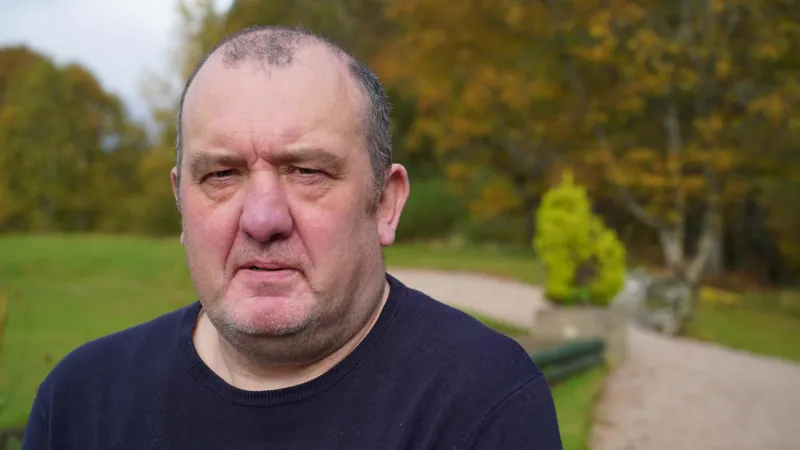
Alastair Munro is encouraging men to get checked out by a GP as soon as they see anything that doesn’t seem right
When Alastair Munro noticed a small lump on his penis was starting to get bigger he suspected he was dealing with something serious.
He put off going to the doctor for about six weeks but as soon as the GP saw him he was told it was likely to be cancer.
“It was quite a bold thing to say,” Alastair, 49, said. “I was shocked. He couldn’t say 100% but he thought it was cancer.
“A week later the urologist at Raigmore said the same thing. Then it was just the case of getting a biopsy.”
Three months after first noticing the lump, Alastair, a construction engineer from Inverness, received confirmation that it was penile cancer – a rare condition that only affects 80 to 90 men a year in Scotland and 700 across the UK.
This story contains graphic descriptions of surgery.
BBC/Dragonfly Film and TV Productions Surgeon CJ Shukla is standing with the large lights of an operating theatre behind him. He has a beard and is wearing surgical scrubs and dark glasses. He is looking into the camera. BBC/Dragonfly Film and TV Productions
Alastair credits surgeon CJ Shukla with saving his life
“I was pretty shocked but had been confident it was cancer,” he told BBC Scotland News.
“I’d never, ever heard of this kind of cancer before. Things moved pretty quickly after that.”
A CT scan confirmed that the cancer was spreading.
Alastair’s surgery was followed by a BBC camera crew and will feature on Wednesday’s episode of Surgeons: At The Edge of Life.
The complex procedure involved the removal of the tumour and 30% of Alastair’s penis in a seven-hour operation.
The cancer had spread to lymph nodes in Alastair’s groin, so they also had to be removed. His penis was then reconstructed using a skin graft from his thigh.
Six weeks later, Alastair, who is originally from Kingussie, had to go under the knife for a further three-and-a-half hours after results from the first surgery showed a small amount of tumour was still present.
There was a 50% chance that the cancer would spread to his pelvic area.
“They can’t actually tell if its cancerous until they get inside you,” he said. “What they actually do is cut away the cancerous nodes and check them straight away. They are basically just digging through you.
“They keep going until they find the end of the cancer. It sounds pretty primitive but that’s what they’re doing. It’s quite amazing really.”
Alastair then underwent a month of radiotherapy and was given the all-clear in February.
He can’t currently have sex or urinate properly because he has developed lymphedema as a complication of the surgery and radiotherapy. This involves swelling of the skin.
Alastair is likely to have reconstructive plastic surgery to improve this in about a year’s time.
He has been warned that there is a high chance the cancer will return within two years.
Raising awareness
Alastair found telling family members about the cancer hard, particularly as it was one many people hadn’t heard about.
But he also had to tell them his surgery was being filmed for a BBC documentary series.
“The whole purpose of it is to raise awareness of men’s cancer,” he said.
“If there’s one person out there who’s got something wrong with their penis but is too embarrassed to go to the doctor and he watches this programme and says ‘I’d better go to the doctor’, that’s basically the whole purpose of it.
“It’s so difficult to spot. There are very few symptoms. It could just be a wee spot on your penis.
“If anyone finds a lump or is having problems with erection or blood, just get checked out.”
BBC/Dragonfly Film and TV Productions Close-up shot of surgeon CJ Shukla’s face. He is wearing a surgical mask, scrubs and dark glasses and is staring into the camera. BBC/Dragonfly Film and TV Productions
Surgeon CJ Shukla works at Edinburgh’s Western General Hospital, one of only two centres in Scotland that can treat very rare male cancers
Alastair’s lump was on the head of his penis. It wasn’t painful but grew, and at one point he noticed blood.
His surgery was carried out by Consultant Urological surgeon CJ Shukla at Edinburgh’s Western General Hospital.
It is one of only two centres in Scotland able to treat very rare male cancers.
Alastair has already seen a preview of the programme.
“I must admit, I thought it was pretty gruesome to be perfectly honest,” he said. “You see in the programme that I have a major bleed. When I watched it I said ‘well nobody told me about that’.
“But my surgeon just said it was nothing, that it happens all the time.”
Despite the gory content, Alastair – who has been back at work for five-and-half months – admits he will probably watch his surgery again when the programme airs.
“I want to thank the surgeons and all the staff at the Western General in Edinburgh and the district nurses,” he said.
“The treatment I got was unbelievable. I can’t fault it at all. I can’t thank the NHS enough.
“Dr Shukla basically saved my life.”
‘Deeply personal’
Shukla, who has been a consultant for 14 years, said Scotland has the highest incidence of penile cancer in the UK.
“The projection is that by 2030 to 2040 it’s just going to go higher and higher so we need to be prepared to look after these patients well, ” he said.
“It’s typical for us to see patients who have sat on this for two or three months before they see doctors.”
He said many patients had never heard of penile cancer and that even with prostate cancer – where there is more awareness – men shy away from getting help due to embarrassment.
He said GPs can also misdiagnose the cancer as the yeast infection thrush, and it is not until weeks of treatment have passed that the patient is referred to hospital.
Even then, they are usually first sent to a local hospital before eventually getting access to one of the specialist centres.
“It’s important for men to act quickly,” Shukla said.
“The question is why are we higher than the rest of the UK?”
He said risk factors included smoking, obesity, hygiene and having human papillomavirus (HPV) – many of which could be linked to social deprivation.
But, he said, anyone could get the condition, no matter their age or social background. He believes Scotland needs more nurse practitioners and psychological support for sufferers.
This is the first time Shukla has featured in the TV series.
“For me, the driving force was to try and see if there would be patients willing to share their story and Alistair is pretty brave to put his story out there because it’s deeply personal,” he said.
“It’s about sharing his story so other men can benefit from this.”
Surgeons: At The Edge of Life will be broadcast on BBC Two at 21:00 on Wednesday, on BBC Scotland at 21:00 on Monday 11 May and is available after on BBC iPlayer.
Breaking News
BUNKERING: Troops Uncover Suspected Illegal Refinery In Rivers, Recover Crude Oil Processing Equipment
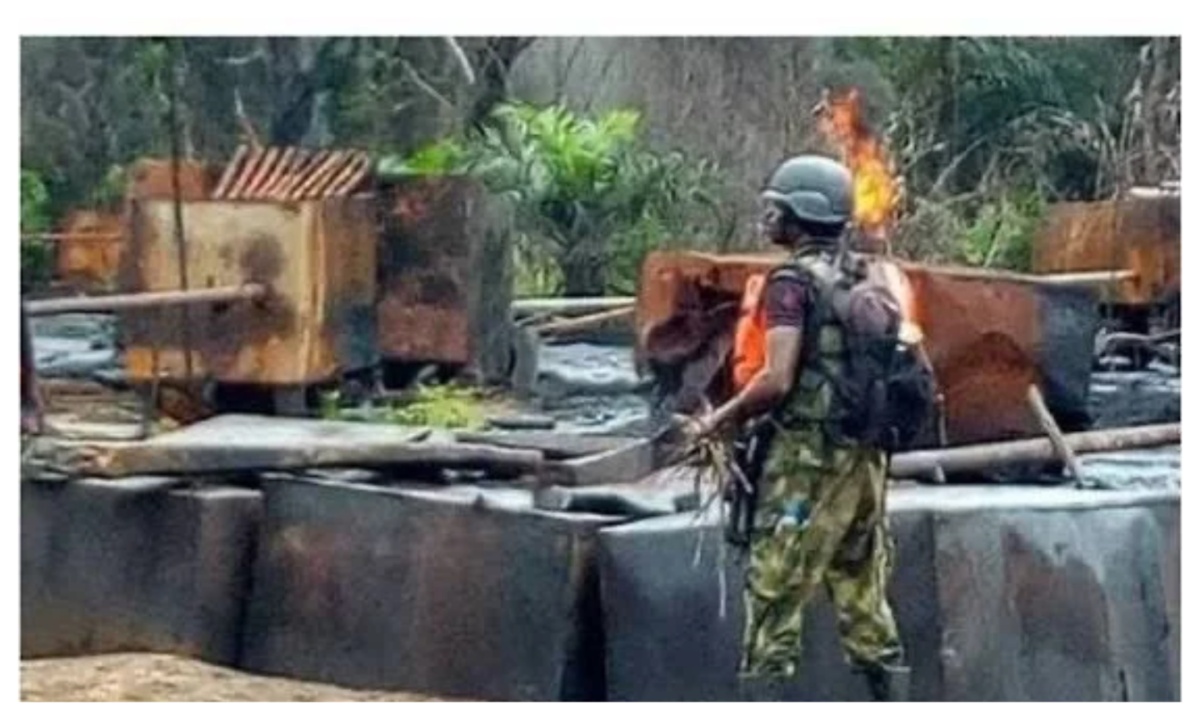
Troops have uncovered suspected illegal crude oil refining equipment during a patrol operation in the Orashi National Forest, Ahoada West Local Government Area of Rivers State.
The development was disclosed in a report by Zagazola Makama, a counter-insurgency and security expert covering the Lake Chad region.
According to the report, the discovery was made at about 12:00pm on Saturday by troops of the 16 Brigade Garrison at Abissa in collaboration with personnel of the 5 Battalion while carrying out anti-crude oil theft operations.
Makama reported that the troops discovered equipment believed to have been used for suspected illegal crude oil refining activities during the patrol.
Items recovered from the site included one large oven drum, one large coolant, two small oven drums, one small coolant, one long galvanised pipe and two sacks containing crude oil.
Makama said the recovered items were handled in line with the operational procedures guiding the ongoing anti-crude oil theft operations.
“The operation forms part of sustained efforts by security forces to dismantle illegal refining camps, curb crude oil theft and protect critical national assets in the Niger Delta region,” the report stated. …For more, Complete your reading.
You may like

A Nigerian-American engineer, Anthony Ehiedu Ugbebor, has asked the Court of Appeal to overturn the judgment of the Lagos High Court which declared that his property purchase agreement with a developer, Mr Olukayode Olusanya and Oak Homes Multinational Services Limited had been extinguished by the doctrine of novation.
The Lagos High Court had in the judgment ordered the refund of the N152 million Ugbebor paid for two luxury apartments in Victoria Island, Lagos.
In a Notice of Appeal filed by his counsel, Barrister Nasir Salau of Nasir Salau & Co., challenging the June 15, 2026 judgment delivered by Justice Akingbola George, Ugbebor argued that the trial judge misapplied settled principles of contract law, ignored material evidence, wrongly dismissed his counterclaim, and erroneously refused his claim for specific performance of the property sale agreement.
The appeal arose from Suit No. LD/4471LM/2023, instituted by property developer Olukayode Olusanya and Oak Homes against Ugbebor and the Economic and Financial Crimes Commission, EFCC, over alleged trespass on two second-floor three-bedroom apartments located at 14A Musa Yar’Adua Street, Victoria Island, Lagos.
Although the Lagos High Court dismissed most of the developer’s claims, it held that the parties’ conduct had effectively terminated their original agreement through novation.
The court also ordered Olukayode and Oak Homes to refund the N152 million previously paid by Ugbebor, while dismissing the engineer’s counterclaim seeking completion and delivery of the apartments or, alternatively, damages.
Dissatisfied with those findings, Ugbebor asked the Court of Appeal to overturn the judgment, restore the validity of the original contract and compel Oak Homes to honour its obligations under the agreement
Ugbebor also urged the appellate court to set aside the judgment in its entirety, arguing that the Lagos High Court’s findings were contrary to the evidence and established legal principles governing contracts.
He maintained that the original agreement remained valid and enforceable and asked the Court of Appeal to compel Oak Homes to honour its contractual obligations.
One of his principal complaints is that the trial judge wrongly placed the burden of proving payment on him instead of the claimant.
According to the Notice of Appeal, the judge erred in holding that he failed to make payments within contractual timelines despite evidence that the payment structure under the agreement was tied to construction milestones rather than fixed dates.
The appellant argued that under the payment schedule contained in Exhibit CW1, 35 percent of the purchase price became payable upon completion of the roofing stage, while the final 20 per cent became payable only upon completion of the apartments.
He maintained that the agreement never required payment on fixed calendar dates and that he had already paid about 80 per cent of the agreed purchase price even though the developer allegedly failed to attain the contractual milestones.
According to him, the trial judge misconstrued the payment clauses and ignored the unchallenged testimony of the defence witness that substantial payments had been made despite the developer’s inability to complete the project as agreed.
He further argued that under the Evidence Act, the burden of proving non-payment rested on Oak Homes, which alleged breach of contract, and not on him.
A major plank of the appeal is the trial court’s reliance on the doctrine of novation.
Justice George had held that the conduct of both parties created a new contractual relationship which effectively extinguished the original agreement.
However, Ugbebor argued that the finding was contrary to established principles of Nigerian contract law.
Relying on the Supreme Court’s decision in Heritage Bank Ltd v. Ajugwo, he contended that novation cannot be presumed merely from the conduct of parties.
According to him, for novation to arise there must be a clear agreement by all parties to substitute the original contract with a new one, coupled with an intention to extinguish the previous contractual obligations.
He argued that no witness testified that such a new agreement existed and no documentary evidence established one.
Rather, he maintained that the conduct relied upon by the trial court was consistent only with issues of delayed performance and alleged breach, not the creation of an entirely new contract.
He therefore urged the Court of Appeal to hold that the original agreement remained valid and binding. …For more, Complete your reading.
You may like
-

 Breaking News7 months ago
Terrorists Want ₦2m ‘levy’ in Katsina Community Despite Peaceful Agreement
-

 Breaking News8 months ago
Ex-EFCC Exhibit Keeper Kaduna Zonal Directorate, Allegedly Steals ₦22m
-

 Breaking News9 months ago
Niger Delta Group hails Tinubu, NUPRC for ₦373bn host community fund and 536 life-changing projects
-

 Breaking News6 months ago
Breaking News: Nigerian Air Force Reportedly Kills 750 Terrorists in Borno State
-

 Business9 months ago
House of Representatives probes $35m modular refinery project
-

 Breaking News9 months ago
UCL: Osimhen Statement after Galatasaray’s 3-1 Win over Bodo/Glimt
-

 Breaking News6 months ago
Nasarawa Insecurity: Suspects Apprehended, Man Hunt Ongoing – Gov Sule
-

 Business2 months ago
BREAKING NEWS: Zenith Bank Rewards Investors with ₦410.69bn Dividend at AGM